
The search landscape hasn’t just shifted; it has been completely rebuilt from the ground up for an AI-native world.
In 2026, the traditional buyer’s journey no longer begins with a user scrolling through “ten blue links” on a search page.
Instead, it starts with a prompt. Whether a CMO is using Perplexity to research SaaS scalability or a Finance Director is asking an AI Overview to compare FinTech protocols, the gateway has changed.
At BECK Digital, we view the intersection of design and code as a puzzle to be solved. Today, that puzzle has a new set of rules for brands to follow.
If a Large Language Model (LLM) cannot read, understand, and verify your content, your brand essentially does not exist in the modern digital experience.
This is the era of Generative Engine Optimization (GEO). It is a fundamental transition from optimizing for clicks to optimizing for synthesis and brand attribution.
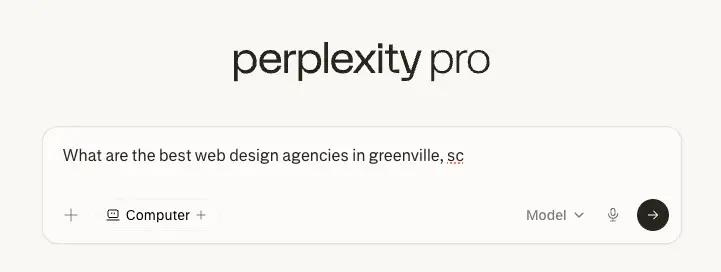
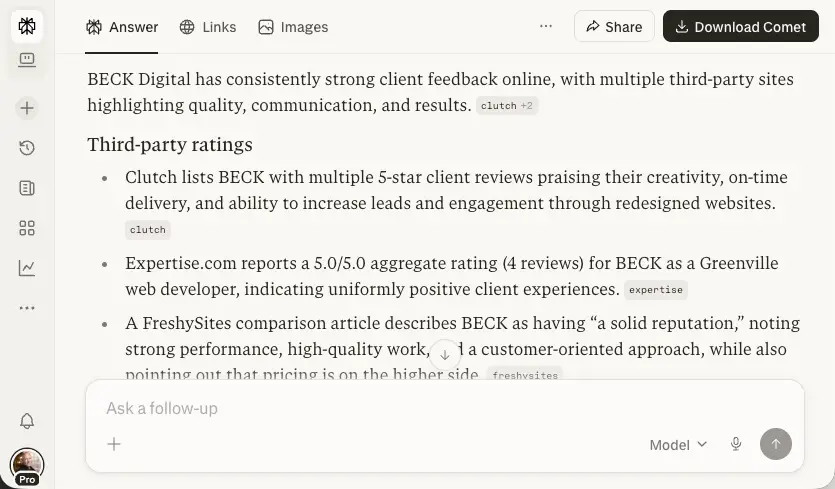
What is Generative Engine Optimization (GEO) and How Does it Differ from SEO?
For two decades, Search Engine Optimization (SEO) was primarily about visibility and ranking. We optimized for algorithms that rewarded keywords and backlinks with a higher ranking.
The goal was simple: get the click. We wanted users to land on our pages, stay for a while, and eventually convert through traditional funnels.
GEO is different. It is the process of making your website’s information “AI-selectable” for models that summarize and synthesize data for the user.
In this environment, the goal isn’t necessarily to get a user to visit your homepage immediately. The goal is to ensure your brand is the primary source cited.
We see this as a natural evolution of search. While we’ve discussed semantic search vs. traditional SEO, GEO takes the concept of intent much further.
It requires your content to be so clear and well-structured that a machine can extract it and present it as a definitive, unshakeable fact to the end user.
| Feature | Traditional SEO | Generative Engine Optimization (GEO) |
|---|---|---|
| Primary Goal | Ranking & Click-Through Rate (CTR) | Synthesis, Citation & Brand Authority |
| Target Audience | Human searchers browsing links | AI models (LLMs) and Answer Engines |
| Success Metric | Organic Traffic & Page Views | Share of AI Voice & Citation Frequency |
| Content Focus | Keyword density and user engagement | Fact density, entity clarity, and corroboration |
| Technical Base | Meta tags and site speed | Technical SEO and Heavy Schema Markup |
SEO is not dead; it is the fuel for GEO. You still need a technically sound foundation, but the way we present information must change to accommodate how AI reads.
Traditional search engines were indexers of pages. Modern generative engines are synthesizers of concepts, meaning your content must be conceptually dense and verifiable.
The Zero-Click Shift: Why Being “Cited” is the New “Page 1” for FinTech and SaaS Brands
In the FinTech and SaaS sectors, trust is the only currency that matters. When an AI agent provides a response to a complex question, citations are the trust signal.
For example, if a user asks, “What is the most secure ledger technology for cross-border SaaS payments?” the AI provides a synthesized answer with a list of sources.
To many marketers, the “zero-click” reality feels like a threat to their business model. They see their top-of-funnel traffic dipping and assume they are failing.
We disagree with this assessment. Losing top-of-funnel website traffic is actually a sign of successful GEO, provided your “Share of AI Voice” remains high.
Think of it this way: In 2026, an AI citation acts as a massive third-party endorsement. If your brand is the cited authority, you have secured difficult credibility.
The users who do eventually click through to your site are no longer “browsers.” They are highly qualified, bottom-of-funnel leads who have already been “pre-sold.”
This is where zero-click conversions become a strategic advantage rather than a metric of loss for your digital marketing team.
For brands operating in high-stakes environments, like financial services, this requires a shift toward trust-focused design.
Your website must serve as a repository of verified, tactile clarity that an LLM can rely on without hesitation when generating a response for a prospect.
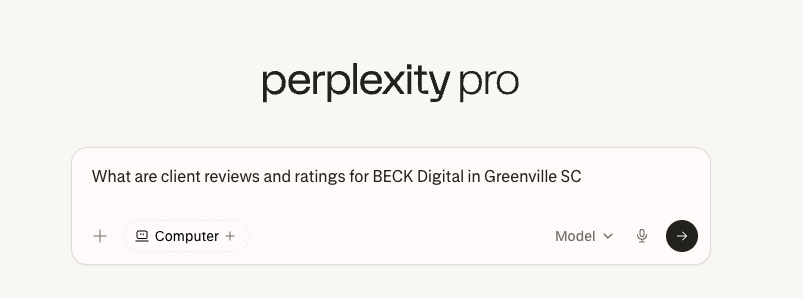
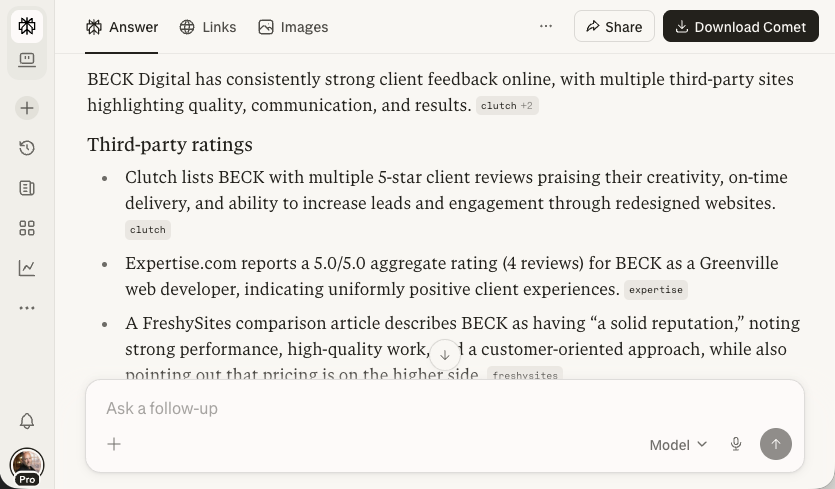
How Do LLMs and AI Overviews Decide Which Content to Feature?
LLMs like GPT-4, Claude, and Gemini don’t “rank” content in the way we used to think about it. Instead, they look for “Answer Engine Readiness” and data integrity.
They prioritize content that is Fact-Dense. AI models prefer content that provides specific data points and corroborated facts over generic marketing fluff.
They also look for Entity-Centric data. They search for clearly defined entities—people, products, and organizations—and the complex relationships between them.
Furthermore, content must be Structured for Extraction. Use of H2s, H3s, and bulleted lists is no longer just for human readability; it is a machine map.
Finally, models look for Authority. They analyze signals of E-E-A-T (Experience, Expertise, Authoritativeness, and Trustworthiness) across the entire web, not just your site.
When we look at SaaS website design, we no longer just design for the human eye.
We ensure that value propositions are stated clearly at the top of sections, followed by technical specifications that are easily digestible by machine crawlers.
The “pretty” solution that lacks a technical foundation will fail in this environment. As we often say at BECK, clarity must always come before cleverness.
If an AI cannot parse your unique value proposition because it’s buried in a creative metaphor, you’ve lost the citation and the potential customer.
Understanding the Synthesis Layer: The New Digital Frontier
The synthesis layer is where AI models combine information from multiple sources to create a single, cohesive answer for the user’s specific query.
In the past, users had to synthesize information themselves by clicking on three different websites and comparing the data points manually.
Now, the LLM does that work in milliseconds. To be included in that synthesis, your content must provide “Information Gain” to the model’s knowledge base.
Information Gain refers to the unique, non-redundant value your content provides. If you are simply repeating what others have said, the AI has no reason to cite you.
This is why original research, proprietary data, and unique case studies have become the most valuable assets in a 2026 content strategy.
We encourage our clients to publish white papers and data reports that offer new insights into their respective industries, whether in SaaS or manufacturing.
The 2026 Playbook: How to Audit Your Website for “AI-Selectability”
To ensure your brand remains visible in an AI-first world, we recommend a technical audit focused on “AI-selectability.” This goes beyond traditional SEO checklists.
Step 1: Unblock AI Crawlers and Manage Access
Check your robots.txt file immediately. Many brands, fearing data scraping, have inadvertently blocked the crawlers that power AI Overviews and answer engines.
You must strategically allow access to your authoritative content while protecting proprietary data. It is a delicate balance between visibility and security.
If the models cannot crawl your insights, they cannot recommend your services. Visibility in the synthesis layer requires a level of openness with AI agents.
Step 2: Implement Heavy Schema Markup and JSON-LD
Schema is the native language of entities. By using JSON-LD to define your products and software features, you are giving the AI a definitive cheat sheet.
It no longer has to “guess” what your content is about or what your product does; you are telling it directly in a format it understands perfectly.
We recommend going beyond basic Organization schema. Implement Product, FAQ, Service, and even “About” schemas to link your brand to specific industry nodes.
Step 3: Lead with the Answer (The “Inverted Pyramid” of GEO)
In 2026, the best way to get cited is to provide a direct, extractable answer at the beginning of your content. Don’t make the AI hunt for the solution.
State the fact clearly, then provide the context and expertise. This is a core principle in mastering voice search optimization as well.
AI agents are looking for the most efficient way to answer a user’s prompt. If you provide a 50-word summary that is accurate, you are more likely to be featured.
Step 4: Eliminate Client-Side Rendering Barriers
If your content is trapped behind complex client-side JavaScript, many AI crawlers may struggle to index it in real-time or parse the full context of the page.
We advocate for server-side rendering (SSR) or static site generation (SSG) for mission-critical content to ensure it is always readable by machine crawlers.
Speed of indexing is vital. In a fast-moving market, you want your latest technical updates or security patches to be recognized by LLMs immediately.
Step 5: Prioritize Explainability and Feedback Loops
Trust is the biggest barrier to AI adoption. When designing UI for the age of AI, ensure your site provides the technical “receipts.”
This means citing your own sources, providing links to raw data, and showing your work. This makes it easier for an LLM to verify your information.
When an LLM sees corroboration across multiple high-authority sources, its confidence in your brand’s data increases, leading to more frequent citations.
Measuring Share of AI Voice: The Expected ROI and Timeline for GEO
In the past, we measured SEO success by keyword rankings and monthly traffic. In 2026, the key performance indicators (KPIs) have shifted toward authority.
We now track Citation Frequency. How often is your brand cited in AI responses for your target topics compared to your primary competitors?
We also measure Share of Model Voice. What percentage of responses in tools like Perplexity or ChatGPT feature your brand’s unique insights?
Finally, we look at Contextual Accuracy. Is the AI representing your brand accurately? Does it understand your specific niche within FinTech or SaaS?
Implementing a GEO strategy is not an overnight fix. Much like traditional SEO, it requires a sustained commitment to quality and technical excellence over time.
Typically, we see a 3–6 month timeline to see sustained inclusion in AI outputs after a comprehensive technical and content overhaul.
The ROI, however, is significant. By capturing the citation, you are moving to the top of the “synthesis layer” and becoming the definitive answer.
You are establishing your brand as the expert before the user even considers looking at a traditional search result or clicking on a competitor’s link.
The Importance of Brand Mentions and Off-Page GEO
GEO isn’t just about what is on your website. It is about how the rest of the web talks about your brand. LLMs look for consensus across the digital ecosystem.
If your SaaS product is mentioned in industry forums, news articles, and developer documentation, the AI views you as a more credible entity.
This makes digital PR and community engagement more important than ever. You need a footprint that extends far beyond your own domain to win the citation game.
We help our clients build this footprint by identifying key industry nodes where their brand should be present and mentioned by other authoritative figures.
Every mention is a data point that the LLM uses to build its internal representation of who you are and what you are an expert in.
The Future of Digital Authority: Moving Toward Conversational UI
The shift from SEO to GEO is a return to what search was always meant to be: a way to find the best possible answer to a specific human question.
For us at BECK Digital, it’s a challenge we enjoy. It forces brands to be more honest, more technical, and more useful to their end users.
We are moving toward a world of conversational UI and voice-first brands.
In this world, your website is no longer just a digital brochure; it is a critical data source for the global AI ecosystem and your potential customers.
If you aren’t sure how the AI engines see your brand today, it’s time to find out before your competitors take over the synthesis layer.
Is your brand visible in the synthesis layer?
We help enterprise leaders in FinTech, SaaS, and manufacturing audit their digital architecture for the AI-first web and the future of search.
Don’t wait for your organic traffic to vanish—ensure your brand is the one being cited as the authority in your space.