

Home » Industries » Retail Web Design
Retail Website Design & E-Commerce
Retail website design is building online stores and brand sites that sell products directly, connect with your physical locations and marketplaces, and keep your catalog visible in search and AI shopping tools. Your e‑commerce website for retailers is no longer just a brochure—it’s the hub of your customer experience, whether you sell in‑store, online, or both. We build high‑performance e‑commerce websites for retailers that create a seamless experience across every channel, helping you attract more customers and increase repeat sales.
The Omnichannel Imperative
Today’s shoppers don’t distinguish between your brick-and-mortar store, your Amazon listings, and your direct website. They expect a single, seamless experience. At BECK Digital, we solve the technical complexity of modern retail—syncing inventory across channels, implementing BOPIS (Buy Online, Pick Up In-Store), and optimizing for the mobile-only user. We turn your digital presence into your hardest-working sales representative.
Engineered for High-Velocity Commerce
Shopify & WooCommerce Experts
We specialize in building bespoke themes and custom functionality on the world’s leading e-commerce platforms, ensuring your site is stable, secure, and infinitely scalable.
Omnichannel POS Integration
Eliminate data silos. We sync your online store with your physical Point of Sale (POS) system for real-time inventory accuracy and unified customer data across all locations.
BOPIS & Local Pickup
Bridge the gap between digital and physical. We implement Buy Online, Pick Up In-Store features that drive foot traffic and reduce shipping friction for local customers.
Amazon Marketplace Strategy
Protect your brand integrity on the world’s largest marketplace. We provide expert management for Vendor and Seller Central, including A+ content and Brand Store design.
Conversion Rate Optimization
Don’t leave money on the table. We use data-driven UI/UX design to fix leaks in your checkout funnel and increase your Average Order Value (AOV).
Mobile-First Design
The modern shopper is mobile. We design for the “thumb-first” experience, ensuring lightning-fast load times and a frictionless checkout on smartphones.
Choosing the Right E-Commerce Platform
The platform decision shapes your costs, flexibility and growth path for years. We build on all three approaches and recommend the one that fits your catalog, team and integrations:
| Platform | Best for | Strengths | Trade-offs |
|---|---|---|---|
| Shopify | Brands that want to launch fast and scale without managing servers | Fully hosted with a large app ecosystem and native connections to marketplaces and AI shopping channels | Monthly subscription plus apps; deep customization requires theme development |
| WooCommerce | Retailers who want full ownership and a content-rich site on WordPress | Open source, highly customizable and strong for combining products with editorial content | You are responsible for hosting, security and updates |
| Custom or headless | High-volume retailers with complex catalogs, pricing or integrations | Complete control over performance, checkout and integrations with ERP and POS systems | Highest build and maintenance investment |
Comparing the two most popular options in more depth? Read our guide to Shopify vs. WooCommerce vs. Magento: Which E-commerce Platform is Right for Your Retail Business?, or see our full e-commerce development services.
Enterprise Technical Rigor for Ambitious Retailers
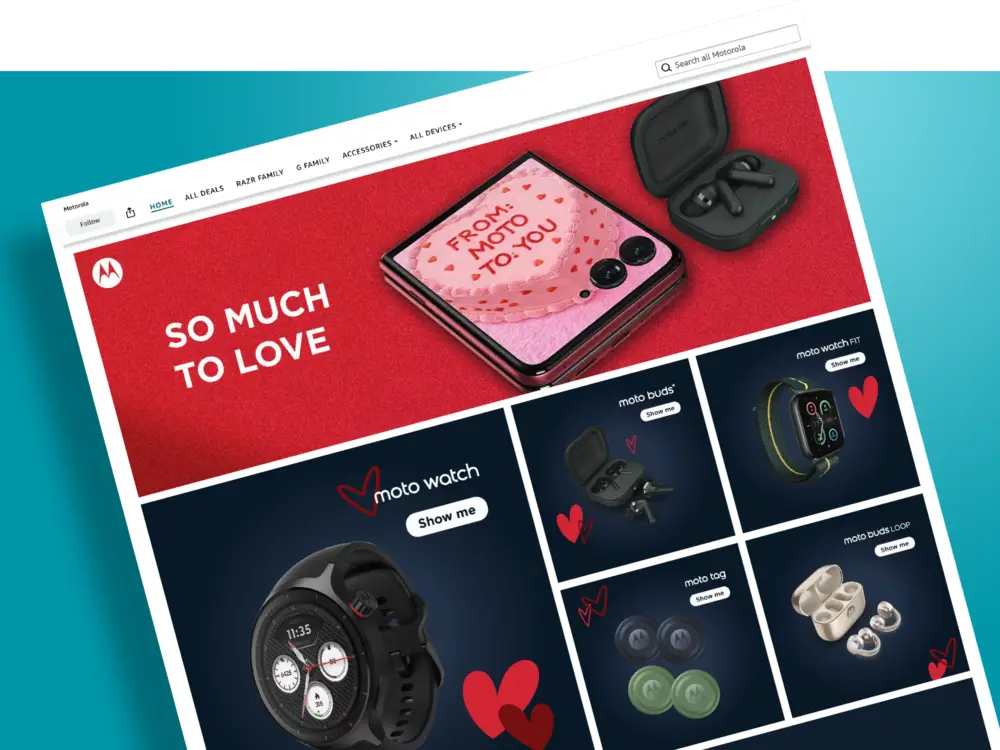
Our history of working with global technical innovators like Motorola and Shell means we bring a level of stability to your retail brand that “creative-only” agencies can’t provide. We build platforms that don’t just look good—they survive holiday traffic spikes and provide the data intelligence you need to grow.
- API-First Custom Integrations
- PCI-Compliant Secure Architectures
- Advanced Customer Data Platform (CDP) Sync
Getting Your Products Found in AI Shopping
Shoppers increasingly ask AI tools what to buy. ChatGPT, Google AI Mode and Gemini, and Microsoft Copilot now recommend specific products, and Google’s Universal Commerce Protocol lets eligible retailers complete sales directly inside AI Mode. These systems draw on product feeds and structured data rather than browsing your store the way a person would. Retailers who get recommended have:
- Accurate, real-time product feeds in Google Merchant Center and connected channels, with current price, stock and shipping details.
- Rich product attributes such as materials, dimensions, compatibility and use cases that answer the conversational questions shoppers ask.
- Product structured data on every product page, including offers, availability, reviews and return policies.
- Helpful product content, from buying guides to comparison pages, that AI tools can cite when explaining a recommendation.
Our AI search optimization and SEO services cover this work, and our Amazon marketplace team keeps your listings consistent across channels.
Retail Website Questions, Answered
Should my retail store use Shopify or WooCommerce?
Shopify suits retailers who want a fully hosted platform that launches quickly and connects easily to marketplaces and AI shopping channels. WooCommerce suits retailers who want full ownership, deep customization and a content-heavy site on WordPress. We recommend based on your catalog size, integrations and in-house resources.
Can you connect our online store to our in-store POS?
Yes. We integrate e-commerce sites with point-of-sale systems so inventory, products and orders stay in sync between your physical locations and your website, which is also what makes buy online, pick up in store possible.
How do we get our products to show up in ChatGPT or Google AI Mode?
Start with complete, accurate product data: a well-maintained Google Merchant Center feed, product structured data on your site and detailed product attributes. AI shopping tools rely on that data to decide which products to recommend, so stale prices or missing details keep you out of the answers.
Should we sell on Amazon as well as our own website?
For many brands, yes, but with a plan. Amazon brings reach, while your own site protects margins and customer relationships. Brand Registry and consistent product content help you control how your brand appears on the marketplace.
Can you redesign our store without losing search rankings?
Yes. We map every existing product and category URL, set up 301 redirects, carry over titles and descriptions, and monitor Google Search Console after launch so rankings and revenue are protected during the move.
Website Design InsightsFor Retail Companies



Ready to Grow Your Retail Brand?
Let’s build a high-performance e-commerce experience that drives sales, engages customers, and elevates your brand. Schedule a free consultation with our team today.